Building the foundation for population health
How do we know what our communities need from the health care system?
A big part of the answer starts with understanding who lives in our communities, the health challenges they experience, and how they use health services. This past year, EYRND OHT took an important step in this direction by developing its first Population Health Management (PHM) tool.
The tool brings population health information together in one place, giving us a clearer picture of the communities we serve across Eastern York Region and North Durham. It looks at factors such as population demographics, chronic conditions and health system use. This helps us see where needs may be greatest and where there may be opportunities to improve how care and support are connected.
One of the things we learned through this work is that data is only part of the picture. The PHM findings give us a starting point, but they are most useful when we look at them alongside what our partners, providers, patients and caregivers are seeing in their communities.
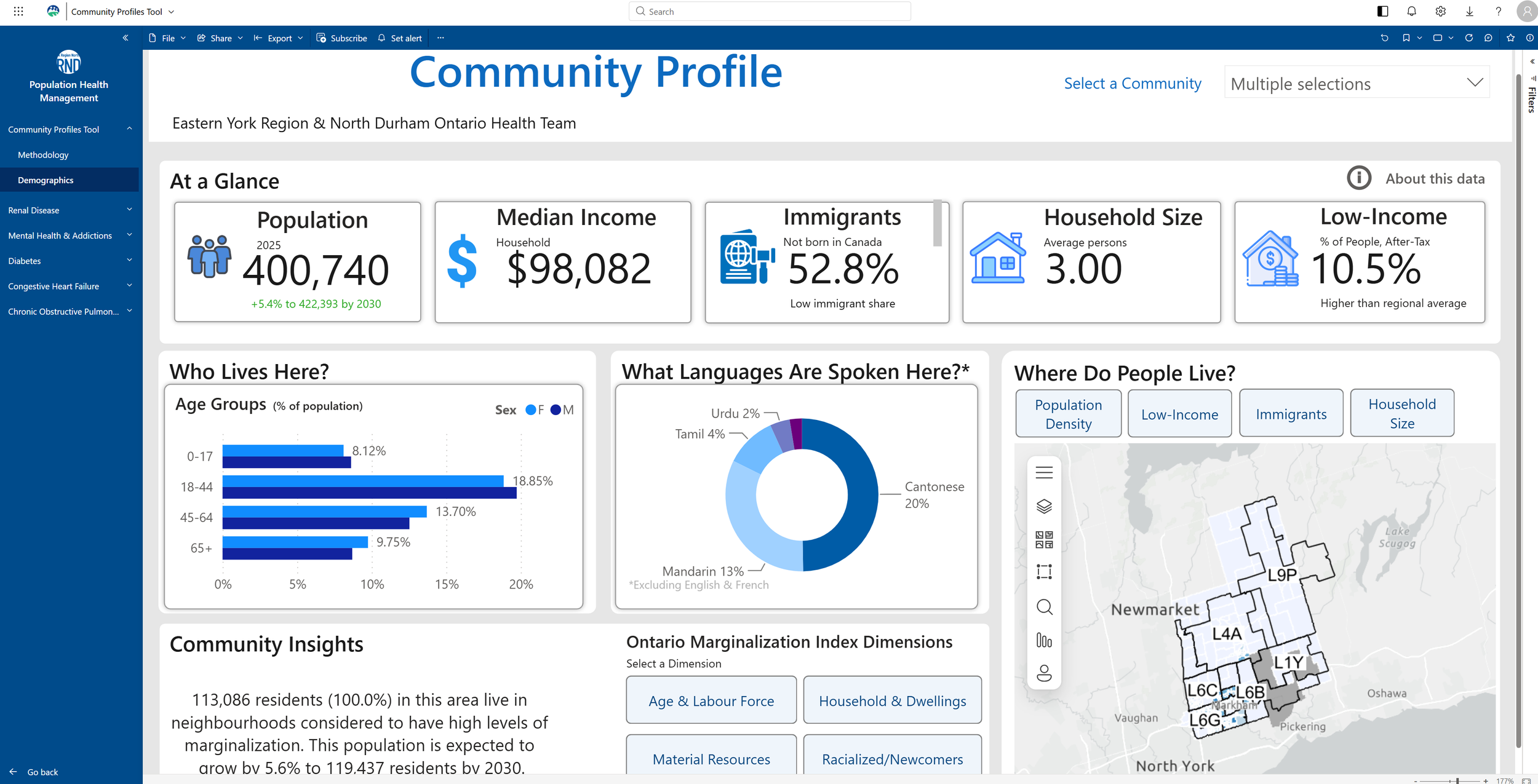
The PHM tool highlighted emergency department (ED) use associated with chronic conditions in our communities. In 2025, ED visit rates per 10,000 people were 176.8 for diabetes, 42.8 for mental health and addictions, and 21.9 for congestive heart failure. These were the highest ED visit rates among the five chronic disease areas studied, reinforcing the importance of addressing both local needs and provincial priorities.
Combined with input from our Primary Care Advisory Council, these insights helped shape the next phase of work: developing more integrated approaches to chronic disease prevention and management, with diabetes, mental health and addictions, and heart failure identified as the initial priorities for pathway development.
The goal isn’t simply to collect more information. It is to use what we learn to help us ask better questions: Where are the gaps? Who may be experiencing the greatest challenges? And where could working together across organizations make a difference?
This is an important first step toward a more coordinated, population-focused approach to care. As we continue to build our understanding of the communities we serve, we can use that knowledge to help guide where we focus our efforts and how we work together.
The PHM tool gives us a stronger foundation to turn what we learn about our communities into action.